
Regularized Shear Localization in Coupled Unsaturated Soil Analysis
A Falcon demonstration of regularized strain localization under constant-suction and constant-water-content conditions in a coupled solid-water-air analysis.
2026-08-04T23:45:00.000Z
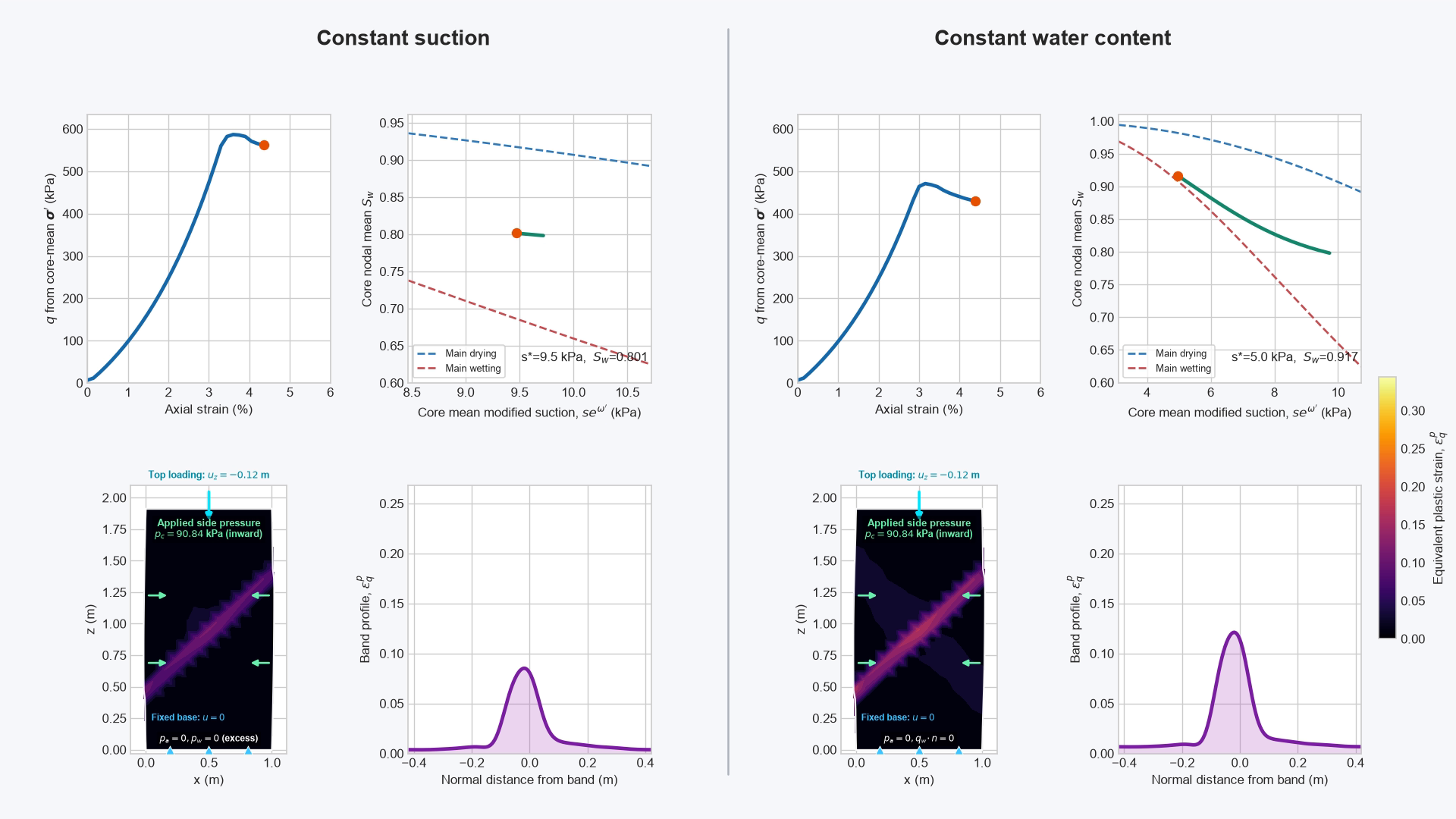
Strain-softening soil models can concentrate deformation into narrow zones. In a finite element analysis, that localization must be treated carefully: without regularization, band width and post-peak response may become strongly dependent on the mesh.
Falcon provides regularization tools for following localized deformation while retaining the interaction between the soil skeleton, pore water, pore air, and hydraulic constitutive behavior.
A coupled unsaturated comparison
The demonstration compares two plane-strain compression analyses with the same mesh, initial mechanical state, loading, constitutive model, and regularization parameters. The difference is hydraulic: one specimen is maintained under constant suction, while the other has drained air boundaries and no water flow across the boundary.
Each side reports deviator stress against axial strain, degree of saturation against modified suction, the evolving equivalent-plastic-strain field, the deformed specimen outline, and the plastic-strain profile normal to the band.
The hydraulic plot uses modified suction s* = s e^omega', where s = pa - pw, e is void ratio, and omega' controls the pore-structure dependence of retention. Main wetting and drying curves are shown together with the computed hysteretic path.
Why regularization is required
Once a constitutive response softens, deformation can collapse into an increasingly narrow part of the mesh. A converged nonlinear solution is not, by itself, evidence that the localized response is objective. The constitutive formulation must include an appropriate length or time scale.
Falcon supports viscoplastic, crack-band, and nonlocal regularization strategies. They address localization differently and are intended to support method, parameter, and mesh-sensitivity studies rather than impose one treatment on every material model.
- Viscoplastic regularization introduces a characteristic time scale into the softening response.
- Crack-band regularization scales the softening law using a characteristic element length.
- Nonlocal regularization evaluates selected internal variables over a finite spatial neighbourhood.
Regularization inside the constitutive update
Falcon supplies the material update with the timestep, characteristic element length, and nonlocal information required by the selected method. Regularization therefore acts within the evolving constitutive response rather than being added as a post-processing correction.
The example uses viscoplastic regularization. The contour shows plastic deformation concentrating into a finite-width band, while the adjacent profile makes its growth and transverse distribution visible. The outline is plotted in the deformed configuration so that compression and lateral bulging can be read alongside localization.
Interaction with hydraulic boundary conditions
Under constant suction, water exchange accommodates changes in pore volume and the hydraulic state remains close to its initial position. Under constant water content, suction and saturation evolve because water cannot dissipate through the boundary. The resulting effective-stress paths lead to different strength and localization histories.
This comparison shows why regularization and hydraulic coupling should not be considered independently. Localization changes deformation and pore structure, while the hydraulic response changes effective stress and therefore the mechanical conditions under which localization develops.
A framework for comparison
The same Falcon workflow can be used to compare regularization method, viscosity or characteristic-length parameters, nonlocal radius, mesh resolution, loading rate, and drainage condition. Global stress-strain response, localization onset, band width, band profile, saturation, suction, and deformed geometry remain available from the same coupled analysis.
Want updates? Learn more.