
NorSand Comes to Falcon: State-Dependent Sand Modeling in Effective-Stress Analysis
Falcon now includes NorSand, a critical-state constitutive model that links sand strength and dilatancy to density and effective confinement for advanced drained, undrained, and coupled analyses.
2026-07-19T19:00:00.000Z
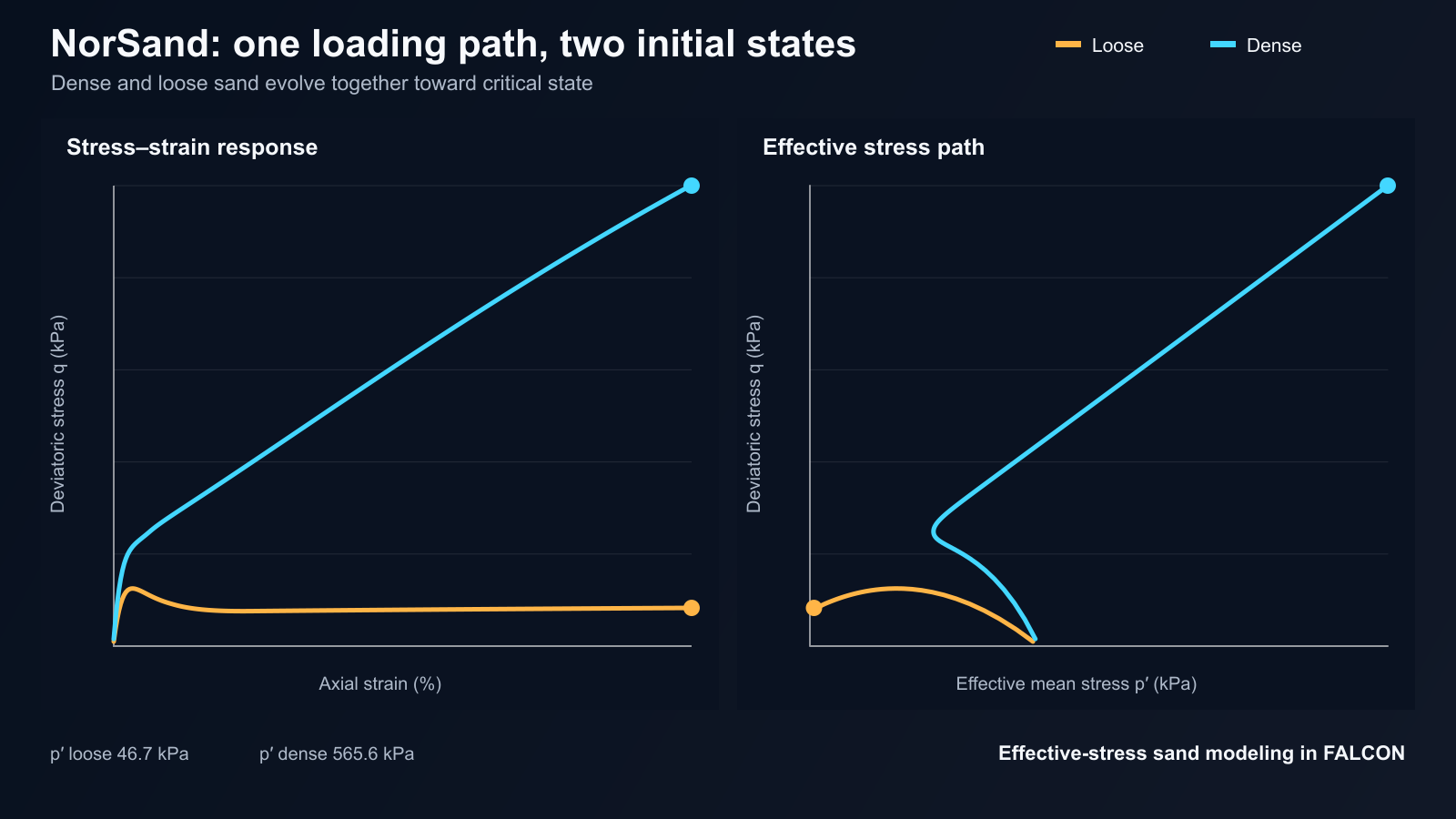
The mechanical response of sand cannot be defined by friction angle alone. Two deposits with similar mineralogy may respond very differently under the same loading because their density and effective confinement are different. One may contract and lose effective stress; the other may dilate and mobilize a pronounced peak resistance.
This dependence on the current condition of the sand is particularly important in problems involving saturated ground, rapid loading, and large changes in stress. It is also the central idea behind NorSand, now available in Falcon.
Model formulation
NorSand is an elasto-plastic constitutive model developed within critical-state soil mechanics and work-hardening plasticity. Its purpose is to represent how sand behavior changes with stress level and void ratio using a compact, physically interpretable framework.
The key quantity is the state parameter, commonly written as ψ. It measures the difference between the current void ratio and the void ratio on the critical-state line at the same effective mean stress [1,2]. A positive value generally identifies a looser, more contractive condition; a negative value generally identifies a denser, more dilative condition.
NorSand uses this state information to control yielding, dilatancy, and hardening. An evolving image pressure defines the size of the yield surface, allowing the model to represent the transition from the initial state toward critical-state behavior [2].
Engineering relevance
Many geotechnical predictions depend on whether sand is contractive or dilative. This distinction affects peak strength, deformation, pore-pressure generation, strain localization, and the potential for instability.
Applications include foundations and offshore systems under rapid or repeated loading; embankments, slopes, and tailings structures; excavation and construction sequences that change confinement; earthquake and liquefaction-oriented effective-stress analysis; and soil–structure interaction where drainage varies in space and time.
NorSand does not eliminate the need for appropriate site characterization, calibration, or sensitivity analysis. Its value is that density and confinement enter the constitutive response systematically within a unified critical-state framework.
Dense and loose sand response
The video compares two undrained triaxial material-point simulations produced with the Falcon NorSand implementation. Both curves evolve at the same time so their different responses can be read directly.
The loose specimen develops a comparatively limited deviatoric resistance while its effective mean stress falls toward a low-confinement state. The dense specimen mobilizes substantially greater resistance and follows a different effective-stress path. Both responses arise from the same constitutive framework; the primary difference is their initial state relative to the critical-state line.
The comparison is a material-point verification example, not a prediction for a particular site. Its purpose is to expose the mechanics of the model before it is used in a boundary-value problem.
Implementation in Falcon
Falcon provides NorSand within an effective-stress finite element environment, with material-point drivers available for calibration and verification before a production model is run. The implementation supports drained and undrained stress paths, logarithmic and power-form critical-state lines, pressure-dependent stiffness, Lode-angle dependence, and alternative constitutive integration schemes.
For saturated-ground problems, Falcon can go beyond an imposed undrained condition. In a coupled analysis, solid displacement and pore-water pressure are solved together. Deformation may generate or dissipate pore pressure; that pressure changes the effective stress carried by the soil skeleton; and NorSand responds to the updated effective-stress state.
In a boundary-value problem, drainage behavior emerges from permeability, drainage boundaries, geometry, and loading duration. It need not be reduced to a single material switch.
Analysis workflow
The addition of NorSand supports a transparent progression from calibration of the critical-state description, through representative stress-path verification and sensitivity evaluation, to coupled finite element simulation.
No constitutive model is universally appropriate, and NorSand should be selected when its assumptions and available calibration data suit the problem. For analyses governed by state-dependent contraction, dilation, and effective-stress evolution, it provides a well-established scientific framework.
Falcon makes that framework available in the same environment used to model groundwater flow, pore-pressure evolution, staged loading, deformation, and soil–structure interaction. That integration is the practical reason this addition matters.
References
1. Been, K., Jefferies, M. G., and Hachey, J. (1991). “The critical state of sands.” Géotechnique, 41(3), 365–381.
2. Jefferies, M. and Been, K. (2016). Soil Liquefaction: A Critical State Approach. CRC Press.
3. Jefferies, M. and Shuttle, D. (2011). “On the operating critical friction ratio in general stress states.” Géotechnique, 61(8), 709–713.
4. Jefferies, M., Shuttle, D., and Been, K. (2015). “Principal stress rotation as cause of cyclic mobility.” Geotechnical Research, 2(2), 66–96.
5. Li, X. S. and Dafalias, Y. F. (2000). “Dilatancy for cohesionless soils.” Géotechnique, 50(4), 449–460.
Want updates? Learn more.