
Falcon brings advanced soil-water retention modeling into one workflow
Falcon supports practical unsaturated soil analysis with major retention curve families, hysteresis, and void-ratio-sensitive SWRC behavior in one modeling environment.
2026-06-29T19:53:00.000Z
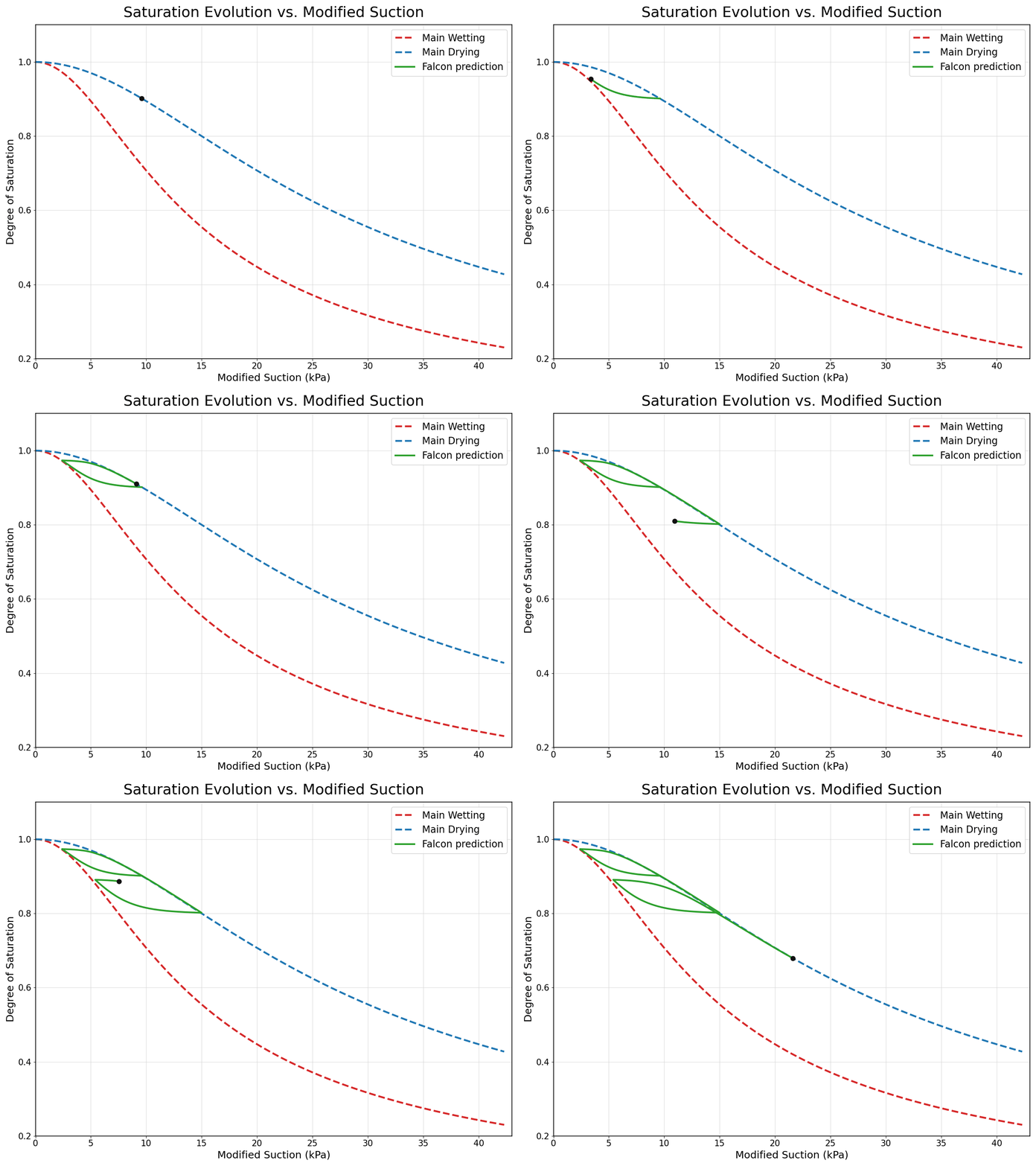
Unsaturated soil behavior depends on how water is held in the pore structure. The soil-water retention curve, or SWRC, describes the relationship between suction and degree of saturation. It is central to modelling rainfall infiltration, evaporation, wetting and drying cycles, suction-related strength, and the transition from dry to nearly saturated conditions.
What Falcon supports today
Falcon now brings the major SWRC choices into one unsaturated geomechanics workflow:
Non-hysteretic van Genuchten retention.
Hysteretic van Genuchten retention with scanning behavior.
Brooks-Corey retention.
Fredlund-Xing retention.
Together, these formulations give teams a broad SWRC toolkit for matching laboratory data, project assumptions, and the level of unsaturated behavior represented in the model.
Why SWRC matters
In an unsaturated problem, changes in suction are associated with changes in degree of saturation, and degree of saturation changes how water, air, and the soil skeleton interact. A well-selected SWRC helps the model represent how the soil moves between dry, partially saturated, and nearly saturated states.
This is especially important in problems involving rainfall, evaporation, near-surface drying, compacted fills, slopes, embankments, covers, and other systems where suction is part of the engineering response.
Hysteretic retention behavior
Many unsaturated soils do not follow a single saturation-suction path during wetting and drying. Rainfall after a dry period, seasonal groundwater movement, repeated infiltration and drainage, capillary barrier behavior, and staged construction can all create reversal histories.
In those cases, the current degree of saturation depends on the path the soil followed. Falcon's hysteretic SWRC captures this by distinguishing the main wetting curve, the main drying curve, and the intermediate scanning curves between them.
Void-ratio-sensitive retention
Retention behavior can also change as pore structure changes. Falcon includes void-ratio-sensitive SWRC behavior for analyses where deformation and hydraulic response are considered together.
The practical point
For practical geomechanics analysis, SWRC modeling should be flexible enough to reflect the data, assumptions, and level of coupling used in the analysis.
Falcon brings these retention options into one workflow, so teams can move from standard SWRC modeling to hysteretic and void-ratio-sensitive behavior without changing environments.
Want updates? Learn more.