Falcon Orbit: agentic RAG for autonomous simulation workflows
Falcon Orbit combines agentic RAG, live model-state planning, typed Falcon commands, and mechanics checks for AI-assisted geotechnical simulation, CAE workflow automation, and computational design.
2026-06-14T12:00:00.000Z
Construction and infrastructure design are becoming more computational, and the language around engineering AI is changing quickly: AI copilots, agentic AI, retrieval-augmented generation (RAG), simulation assistants, CAE workflow automation, and computational design are all pointing at the same shift.
Teams are expected to compare more options, account for more uncertainty, document more assumptions, and move faster from concept to decision. The pressure is not only to run one accurate model. The pressure is to build a workflow that can absorb changing project information, update the analysis, preserve the reasoning, and make the next design iteration easier than the last one.
Falcon Orbit is that layer for Falcon: an AI-assisted workflow system that connects project context, model setup, local retrieval-augmented knowledge, solver execution, and result checks inside one geotechnical simulation environment.
The gap is between information and action
Engineering work begins with context: drawings, reports, material tables, load cases, construction stages, comments from reviewers, previous model revisions, and project-specific assumptions.
Finite element software needs action: geometry commands, material assignments, mesh choices, boundary conditions, loading, analysis settings, output requests, and checks.
The expensive part is the conversion between those two states. It affects productivity because engineers repeat setup and interpretation work across revisions. It affects accuracy because assumptions can be lost as information moves from reports to model files. It affects design quality because fewer options are explored when every iteration requires too much manual reconstruction.
Orbit is more than a prompt box
Orbit is being built as a workflow system with three connected capabilities: model-state planning, agentic RAG, and mechanics-aware validation.
First, Orbit reads live Falcon model state. It can use the current geometry, materials, boundary conditions, mesh settings, stage state, and analysis configuration as context before proposing the next step. The output is a typed command plan that can be reviewed and executed inside Falcon.
Second, Orbit uses retrieval-augmented generation. The goal is to ground answers and plans in Falcon documentation, GUI command references, project history, run artifacts, validation notes, and model-specific context. The direction is agentic RAG rather than static retrieval: retrieve context, decide which model information matters, propose the next action, and connect that action back to Falcon.
Third, Orbit connects to mechanics checks. Geotechnical simulation needs more than fluent explanations. Settlement, stress distribution, stability checks, material endpoints, and result interpretation need independent baselines where they are available.
- understand the engineering context
- retrieve the relevant project and technical knowledge
- propose the next model-building actions
- execute approved Falcon commands
- check results against available mechanics references
- preserve the workflow trail for review
Why this is timely
Computational design is changing the role of analysis in construction, infrastructure, and geotechnical engineering.
In construction, geotechnical design, and infrastructure delivery, analysis is increasingly part of an iterative process: compare alternatives, update assumptions, evaluate construction sequences, adjust geometry, rerun staged models, and explain the consequences to a wider project team.
Orbit addresses the workflow around the solver. That is where autonomy becomes valuable for engineering teams: as a system that helps turn changing project context into traceable model actions and reviewable results.
The demo: problem image to Falcon workflow
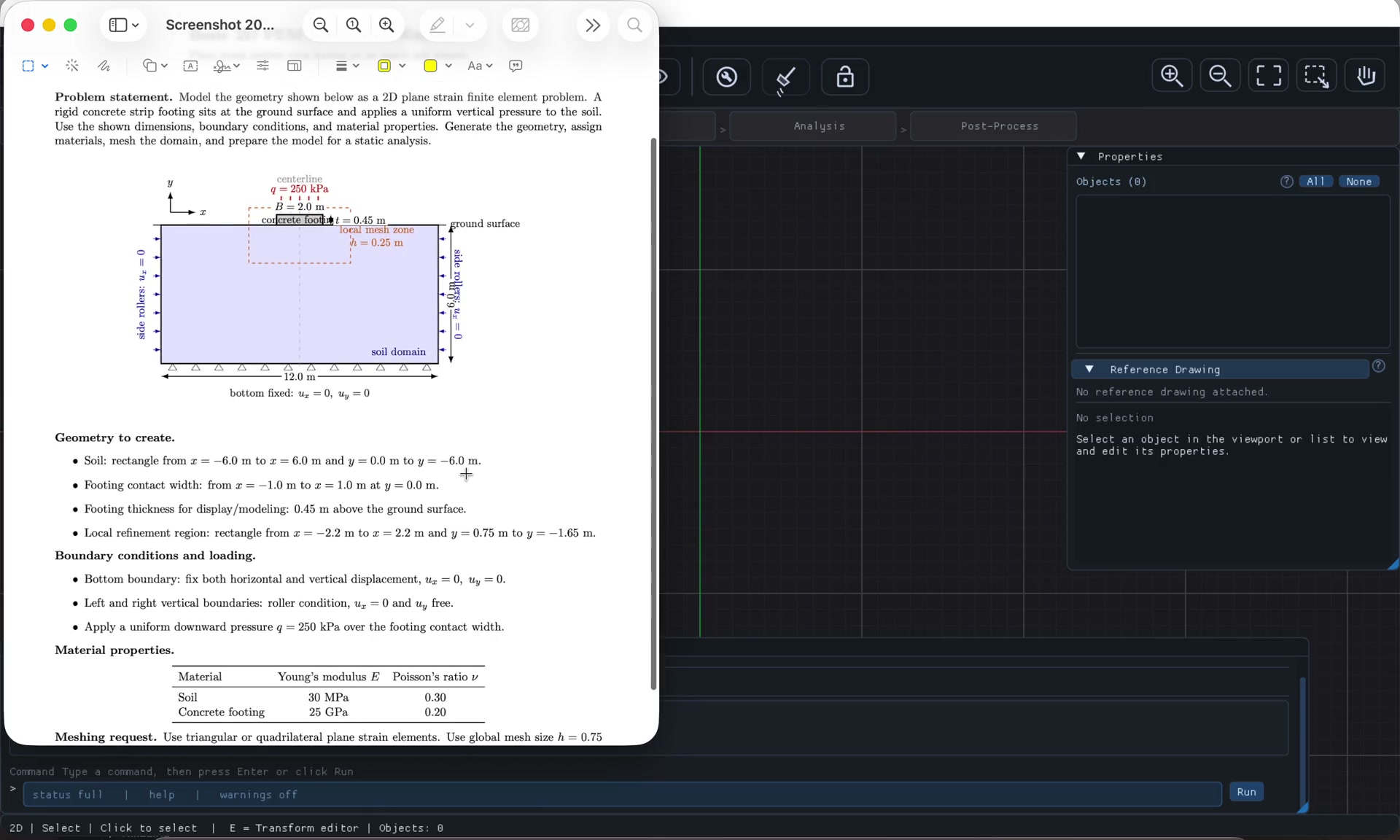
The current Orbit demo shows one part of this direction: a 2D foundation problem image becomes a structured Falcon model setup workflow.
The video starts from the problem statement image, brings it into Falcon, and shows Orbit moving toward the setup workflow. The significance is the pattern:
- an engineering brief is treated as model intent
- the intent is organized into setup actions
- the setup remains visible before execution
- the workflow points toward solve and review rather than stopping at text generation
That same pattern extends to more complex geotechnical and construction workflows: staged excavation, embankment construction, slope stability, foundation settlement, liquefaction studies, parameter updates, and design-option comparison.
Toward full workflow autonomy
Full autonomy in engineering simulation requires more than a language model. It requires context, retrieval, command execution, physics checks, and auditability.
The near-term value is productivity: faster movement from project information to model setup, fewer repeated manual steps, and clearer continuity across revisions. The deeper value is computational design quality: more alternatives can be tested, assumptions can be tracked more consistently, and the reasoning behind each analysis can stay connected to the model.
Falcon provides the simulation engine. Orbit adds the workflow intelligence around it.
Want updates? Learn more.