Dynamic Coupled Analysis for Saturated Ground
Where pore pressure, stress, and motion evolve together in saturated dynamic geomechanics.
2026-07-04T23:25:00.000Z
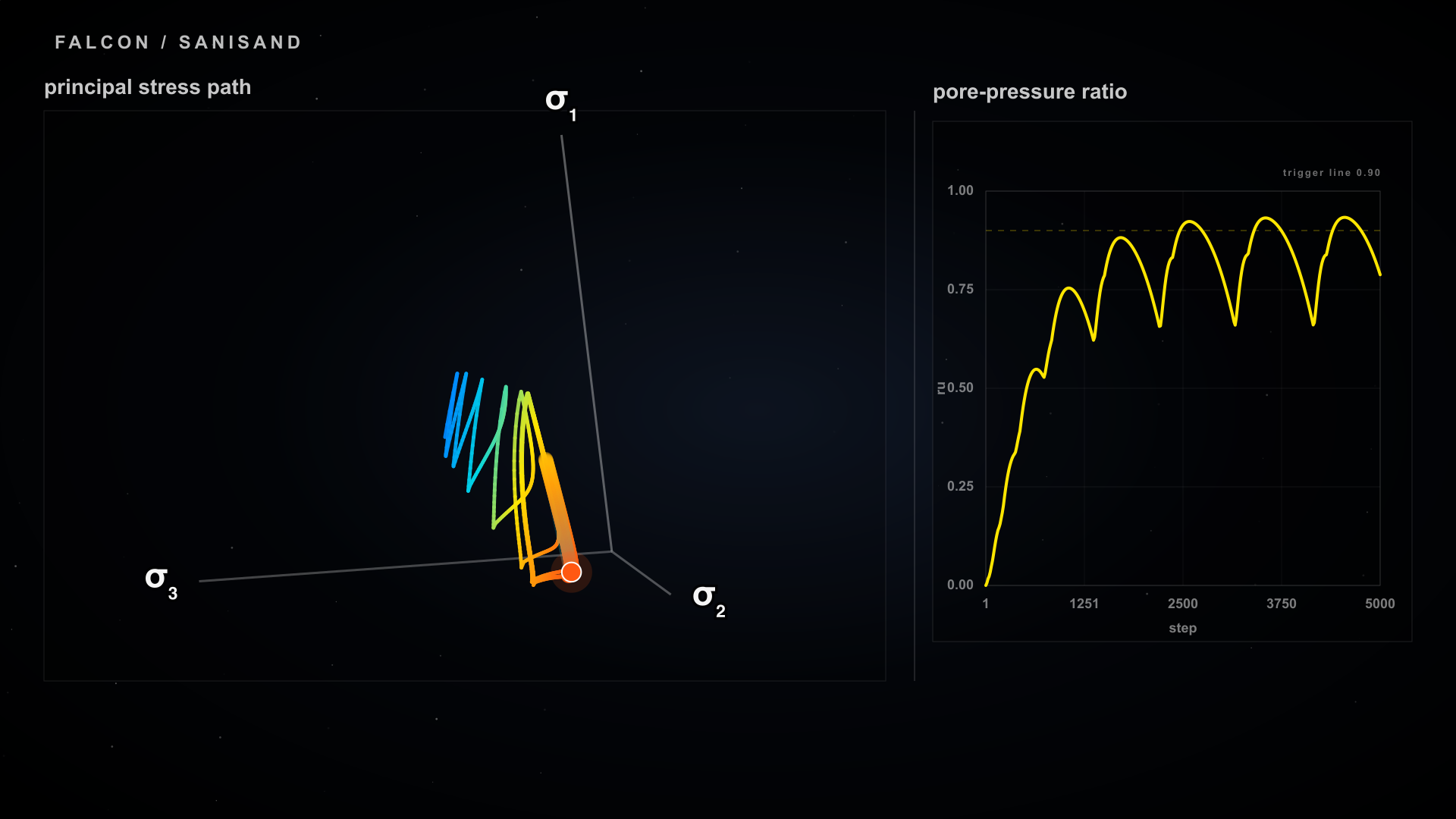
Where pore pressure, stress, and motion evolve together
In saturated soil and porous media, dynamic loading does more than move the ground. It can change the ground while it is moving.
As the soil skeleton deforms, pore-water pressure may rise, dissipate, or redistribute. That change alters effective stress, which in turn changes stiffness, strength, damping, and deformation. In many geotechnical problems, this feedback is not a secondary effect. It is the response.
FALCON's dynamic coupled analysis solves solid displacement and pore-water pressure together, capturing the interaction between motion, stress, and pore pressure in one coupled workflow. The theoretical background is summarized in the coupled formulation notes.
This capability is critical when loading is rapid, cyclic, or seismic, and drainage conditions cannot be simplified.
Applications include:
earthquake site response in saturated deposits
liquefaction triggering and post-liquefaction deformation
offshore foundations under wave, wind, and seismic loading
tailings dams, saturated embankments, and earth structures
rapid construction, drawdown, blast, and impact loading
soil-structure interaction in saturated ground
Watch the animation: dynamic coupled saturated response.
Different problems require different constitutive models. Some demand robust nonlinear cyclic behavior. Others require contractive sand response, pressure-dependent stiffness, cyclic mobility, or liquefaction-capable plasticity.
Coupled analysis is one of FALCON’s core capabilities. The platform is designed for advanced geotechnical simulation, supporting dynamic coupled finite element analysis of saturated porous media and constitutive models tailored to seismic, offshore, liquefaction, and soil–structure interaction applications.
The result is a simulation where pore pressure, effective stress, stiffness, and motion evolve together. Under cyclic or seismic loading, this coupling can control deformation, instability, and liquefaction - and FALCON is designed to capture that response directly.
Want updates? Learn more.